
becoming one with art
the art of close looking: performing Kant's free play with Lee Chung-Chung's painting The Fortune of the World

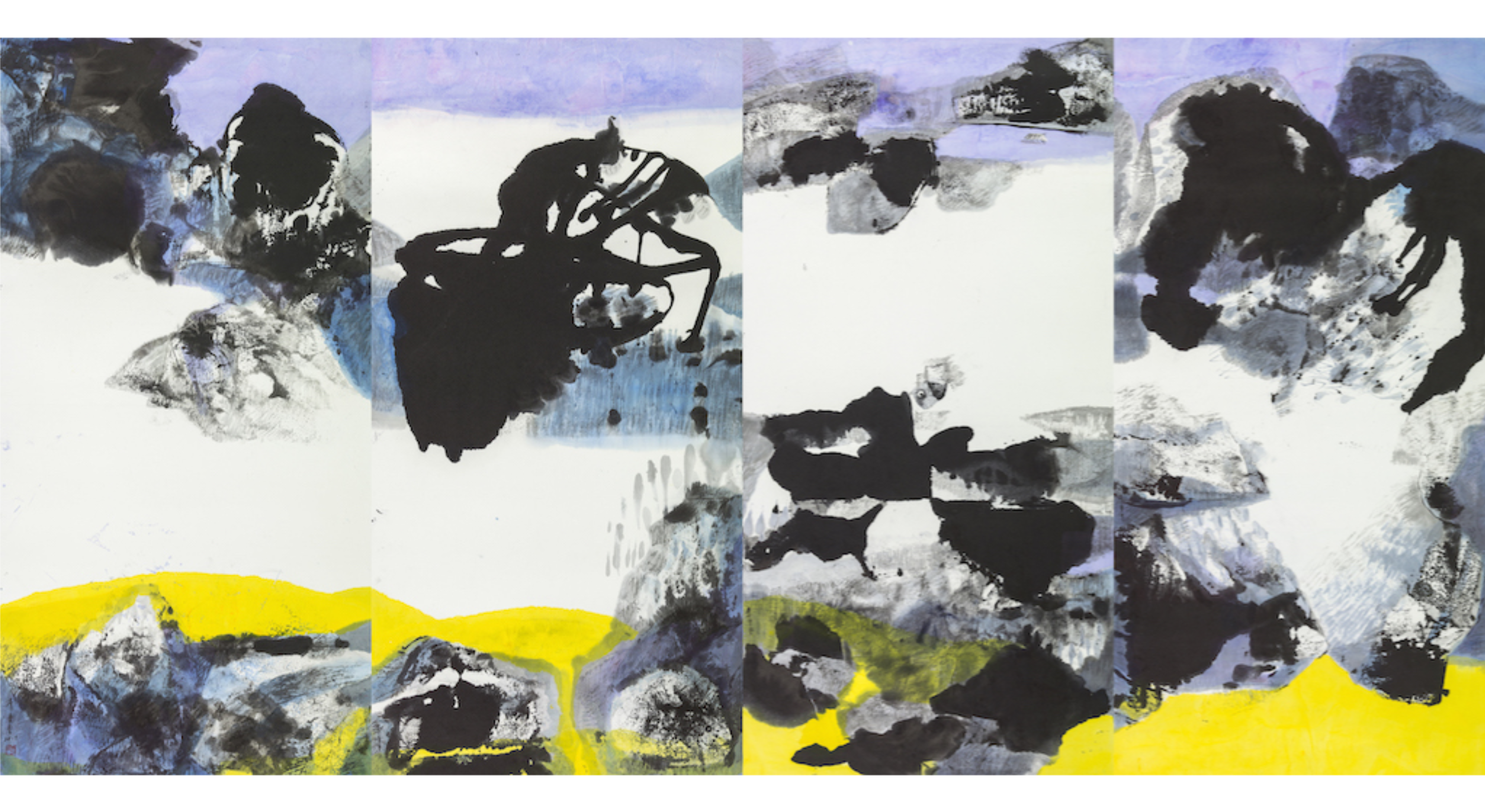
At this very moment, you’re encountering Lee Chung-Chung’s The Fortune of the World, pictured above, likely for the first time. How do you engage with it? What is your experience of her splatter—and absence—of ink and color?
If you’re anything like how I used to be, these questions might be impossible for you to answer. For much of my life, I didn’t believe I had the authority to engage with visual art imaginatively. I was uncomfortable with the notion that I could go beyond mere description and actually experience an artwork—position it within a grand story, one driven by nothing other than the rich depths of my mind. Had someone asked me what I thought the painting was about, I might have skirted the question with an inoffensive “I like the colors.” If I were feeling adventurous, I would have thrown in something like, “The ink blots look kind of like animals to me.” What more could I say? I don’t know anything about the artist or the movement her artwork comes from. I would much prefer to react to a critic’s analysis of the piece than give credence to my own experience of it, much less allow my experience to unfold in the first place.1
On a few occasions, my brain would rebel against the flood of anxious thoughts and trepidatiously offer an interpretation of the artwork, something like, “The whale leaping out of the ocean in the first panel looks like it’s having fun, but it’s also making me feel like I’m in danger.” But the mind is not a single entity; it is composed of many, sometimes competing, selves: the version of me who felt comfortable molding an artwork with the eyes and heart of a child would inevitably be shut down by the drill sergeant in me who depended on materialist understandings of the world to feel secure.
It’s not clear to me why this restrictive mentality plagued me for so long—a prison of my own making, to be sure. I know many people, just as inexperienced with visual art as I am, who can take one look at a painting and let their imagination somersault through it. If an artwork struck me as beautiful—because of, let’s say, the colors or textures—I would feel its beauty deeply: shed a tear, laugh, shudder, and reflect in overwhelming awe at just how small and insignificant, or large and miraculous, it made me feel in the world. But that is half the equation. Why couldn’t I allow myself to translate those feelings into words? To explain why the art in question made me feel that way, or why it should be considered good art?
The thing about closing yourself off to the full experience of art is that you miss out on one of life’s deepest pleasures. To see an artwork for the first, fifth, or even twentieth time and feel satisfied with your immediate take and nothing more (“this is beautiful; I like the colors” or “what is this? I don’t like it”) is to turn a blind eye to the unconscious—yours, the artist’s, and a unique third that emerges when yours and the artist’s interact. An artist’s creation is not simply a form of self-expression but a message channeled from something greater than them. If that is the case, and I believe it is, then it is imperative that we play with the artwork by participating in an exercise called close looking. When we look at an artwork closely, we let go of all preconceived notions about art and experience the work for what it is—we do not bring a rubric for judging it. We let it speak to us, and vice versa.
The first time I experienced this imaginative play with an artwork—what Kant calls free play—was in Geoffrey Mak’s online cultural criticism class, in a lecture specifically on close looking. As a warm-up, he spent the first half of the three-hour class alternating between his lecture and short close-looking exercises. We would sit with an artwork in silence for a couple of minutes, read and analyze a critic’s formal description (i.e., experience) of the artwork, and then share how we felt about both the artwork and the critique. As you can imagine, I was really uncomfortable doing this and felt that my experiences were inadequate compared to everyone else’s. Sometimes, my classmates’ descriptions matched mine, and so I felt more comfortable with my interpretative abilities. Sometimes, they differed from mine and each other’s, which helped me understand that there isn’t necessarily a right or single interpretation or experience—there is just interpretation and experience.
But the second half of the class is what shifted my experience with artwork forever. Mak guided us through a 15-minute meditation to get in touch with our bodies and the present moment, and then guided us through another 15-minute meditation to get in touch with Lee Chung-Chung’s The Fortune of the World and write about it. The second meditation began simply, with a few deep breaths and some questions about our sensory experience of the painting. What colors do you see? What movement is happening right now? More of that, interrupted only by silence and the sounds of my keyboard as I jotted down my experience. My notes during this stage of the meditation were painfully self-conscious. They were short and mostly descriptive, punctuated by the occasional “I’m confused.” At one point, I almost gave up and wrote: “I feel critical of myself for not being able to understand this or feel it more. Why am I feeling this way? The painting is making me insecure. I don’t know what I’m seeing.”
Then, the meditation took a pivotal turn: Now let the division between you and this artwork fall away. This artwork is now an extension of you. You and this artwork are one. You are this artwork. What are the new ways of knowing this artwork, now that it is part of you?
Instantly, my imagination poured out—and there was no stopping it. I was in a flow state, transcribing the wild and absurd associations my mind was making, and I was doing it with the utmost glee. I wasn’t even thinking about how, just moments before, I had very little to say. This meditative approach to artwork is overpowering, in the best way possible: you are no longer in your physical body, on Earth, confined by the laws of physics—but somewhere else, where time and space are suspended, and your thoughts and emotions and bodily sensations have free rein to rule and play in all their childlike wonder, and you know, deep in your bones, that whatever you’re experiencing in relation to this artwork is exactly right, and no one can tell you otherwise. Of course the blot in the first panel is a whale—how could it be anything else?
Keith Johnstone, in his book Impro, describes this experience perfectly. When he asks people to lie down, close their eyes, and report what their imagination gives them, he explains that they go into a deep state of absorption. Instead of feeling like they are just “thinking things up,” they feel the experiences really happening to them. If he asks them, “Did you feel the floor?” they would respond, “There wasn’t any floor.” “Did you experience your body?” “I wasn’t in my body.” If he suggests a scene—“You’re on a beach”—and asks, “Is it sandy or stony?” the person might respond, “Sandy.” “Did you think that up?” “No, I just knew.” This is what happens when you surrender to an artwork and really let yourself experience it—whether that work is a book, movie, song, sculpture, or painting.
So, take a deep breath and observe The Fortune of the World again. What do you see? How do you experience it?
For me,
the piece is unsettling. It’s hard to ignore, for instance, the imposing black figure in the second panel. What is it? The spindly legs, opportunistic crouching, distressing blot of black. Every bone in my body is screaming that it’s a cockroach feeding on some unidentifiable mass: a life-affirming act that makes me recoil in terror. Despite my visceral disgust, there is no escaping the insect, violently foregrounded by the absence of color, stranded in whiteness between the soft blue-gray and purple, neither of which will touch it. It is the star of the piece, unbeknownst to the poor creature—I’m sure it would like its privacy.
If the chilling white provides little comfort, the blinding yellow actively distresses. It cuts through the entire painting, resisting all attempts to slow it down, including the mountainous terrain in the third panel—a battleground for domination. The cluster of ink blots drifting toward the river at a glacial pace crowds the lower half of the painting and briefly pollutes the yellow stream. But to no avail: the yellow purifies itself back to its toxic essence by the fourth panel, unperturbed. The stream’s color is less honey- or gold-like and more reminiscent of dehydrated piss. It moves rapidly; attempts to outrun or stop it are futile. Coexistence—black and yellow, life and death, awe and horror—is the only option.
Consider the top of the first panel. Far from the toxicity of the yellow, an orca leaps out of the water. With the hazy, violet sky as its stage, the killer whale is seconds shy of completing an elegant flip. Her ocean is still, but only for now; there is a moment of silence before the thunderous splash. Her play strikes with overwhelming beauty from a distance. Look a little longer, though, and it becomes clear why the Greeks believed that the beautiful coexists with the terrifying. Will she land back in the little that’s left of her habitat, or lose herself in the black holes hovering near her?
Life is fragile, and the natural elements, beautiful as they are, stop for no one and nothing. I can hear the unceasing howl of the wind pervading all the colors, reminding me that for now, I am alone. I move through this painting with vigilance.
When I re-emerge from my absorption into the painting—back into my body and the physical limits of the world—I’m almost shocked at what I experienced and wrote. Did this really come from me? But this disorientation is one of joy. I think the surprise at what we produced is a sign that we were living life to its fullest in that moment.
I’m similarly astounded by my classmates’ experiences of the artwork. One person said the painting brought her serenity and changed her relationship with water. A couple of people felt the powerful forces of time. For one, the mustard yellow was the past, idyllic lilac was the future, and she was trying to exist within the present, the white gulf in the center, while the black gunk floated in between. The other was reminded of her memories: black being the viscous memories that form our self-perception, white being the large gaps in memory, and yellow being the false beckonings of nostalgia. In fact, another person felt the sweet nostalgia of his childhood in the painting.
Someone explained he couldn’t embody the painting because its four panels made it unsteady; he couldn’t find a personality and was uncertain about where to look. He did not consent to embodying the painting. The panels provoked sadness for another person: they were an explosion, a coming apart rather than coming together. The colors, he explained, were like parts of a person: the complementary yellow and purple were pleasing, but one can only notice the blacks and whites within oneself.
For some, the black ink blots were not of nature, but calligraphy describing the painting’s landscape; for others, they were redactions—erasures—shadows—bodies turned inside out—that elicited fear. One person, like me, saw an unsettling creature in the blacks and found the yellow malicious and clandestine; another person, like me, felt the blacks invading the peaceful absence of color. One person tasted the painting—it was sweet, if you were curious.
There is an infinite number of experiences in life, and for each one, an infinite number of experiences of an artwork. My expedition through The Fortune of the World, and my classmates’ experiences, too—these are the chemical reactions produced by the interaction between artwork and observer. They are part of the emergent unconscious that exists all around us, all the time, waiting for us to notice it.
This reminds me of a scene in Whit Stillman’s fantastic film Metropolitan (1990), where a character says, “I don’t read novels. I prefer good literary criticism. That way, you get both the novelists’ ideas as well as the critics’ thinking. With fiction, I can never forget that none of it really happened, that it’s all just made up by the author.”
this was such a delight! I've had so many of the exact same thoughts and your description of the meditation exercise really put me into that state of absorption for a second. also, what a gorgeous painting
Art needs you! As an artist I can confirm that there are too many paintings locked away in wordlessness, just waiting for the warmth and generosity of your real attention and voice. So beautiful to read come across this electric absorption and freedom of play in just one encounter, what else is possible?!